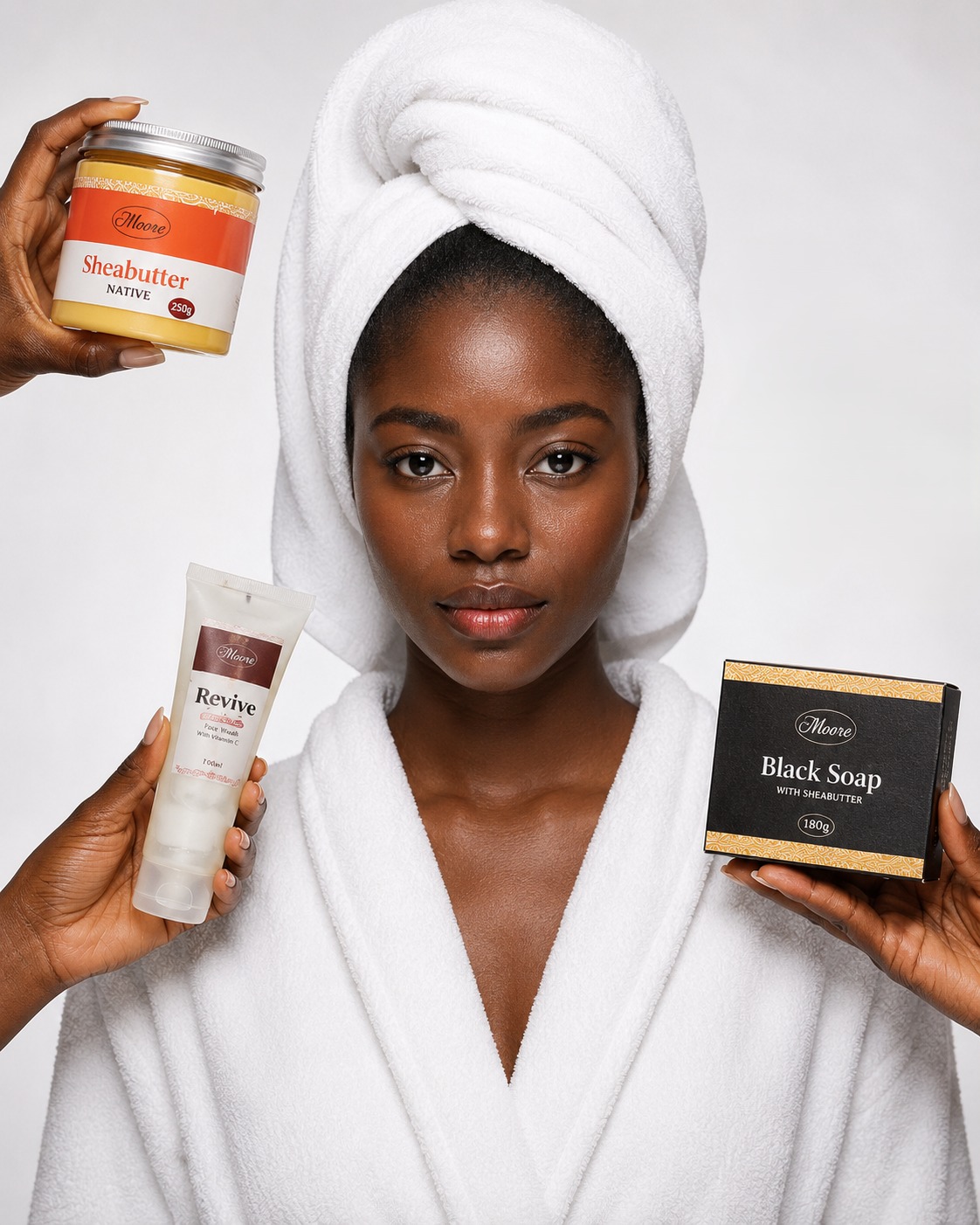
African does not automatically mean ethical. Here’s what actually happens between a shea nut falling from a tree and the jar on your shelf — and why the answer matters more than whether the product “works.”
You know where your skincare ends up — on your face. But do you know where it begins?
Not on the shelf. Not at the factory. Not even in the little bottle with African botanicals printed across it. It begins much earlier: with a shea nut falling from a tree, with a woman in Northern Nigeria separating what can be used from what cannot, with a seed, a fruit, a bark, an oil. Long before it becomes an ingredient, it is somebody’s work — and that’s the part of African skincare we rarely see.
What Does “Ethically Sourced” Actually Mean?
We’ve become very good at asking what a product does. Does it brighten? Does it moisturize? Does it help with acne? Does it smell good? There’s another question worth putting on the label: where did this come from?
Ethically sourced shea butter means the raw ingredient can be traced back to who grew it, who harvested it, and who was fairly paid for that work — not just that the finished product is labeled “natural” or “African.” Those are two different claims:
- African describes origin. It says nothing about who benefited from the sale.
- Natural describes formulation. It says nothing about how the ingredient was sourced, processed, or paid for.
- Ethically sourced is the only claim that actually answers the question of who was compensated fairly along the way.
A beautiful story about an ingredient doesn’t tell you who profited from it. The real story is in the journey: who grew it, who harvested it, who processed it, who bought it, who added value to it, and who was paid for that value.
The Journey Before the Jar: How Shea Butter Is Actually Made
Before shea butter reaches a bottle, it passes through hands most consumers never see:
- Harvest — wild shea nuts are gathered by hand, largely by rural women, from trees that cannot be farmed or domesticated.
- Processing — nuts are cracked, boiled, and whipped into paste using methods passed down for generations.
- Refining — paste becomes raw or refined butter, depending on the intended use.
- Formulation — butter is blended into finished skincare products.
- Sale — the finished product reaches a shelf, a marketplace, or a jar in your hands.
Every step between “wild shea nut” and “jar” is a point where value is either shared with the women who did the harvesting — or captured entirely by someone further down the chain. That gap is the whole story of the global shea industry.
Is Your African Black Soap Bar Actually Authentic?
If you’ve searched for an authentic African black soap bar from Ghana or Nigeria, you’re really asking one question: is this actually connected to the tradition it claims to represent, or is it an imitation cut with synthetic dye and fragrance?
Authenticity comes down to three things:
- Ingredients — traditional black soap is made from roasted plantain skins, cocoa pod ash, and raw shea butter — not synthetic fillers.
- Origin — was it actually made in Ghana or Nigeria, by people connected to the practice, or manufactured elsewhere and marketed with the story attached?
- Process — was it hand-crafted in small batches following the traditional method, or mass-produced at scale with shortcuts?
The ingredient’s origin is only the beginning, though. What happens after harvest — who processes it, who formulates it, how much value is created between raw material and finished bar — is just as important as where it came from.
Why “African” Doesn’t Automatically Mean “Ethical”
This is the sentence worth remembering: African does not automatically mean ethical, and natural does not automatically mean responsibly sourced.
African beauty is not simply about finding traditional ingredients — it’s about what’s done with them afterward. A brand can source a genuinely African ingredient and still capture all the value for itself, leaving the people who did the harvesting no better off than before.
Building an African Beauty Economy, Not Just Sourcing African Ingredients
At Moore Organics, we believe Africa shouldn’t only be the place the beauty industry goes to find ingredients. It can be the place where those ingredients become something more — more research, more formulation, more manufacturing, more ownership, more value staying close to where the story began.
Our own starting question isn’t “what African ingredient can we put in a jar?” It’s “what kind of beauty economy can we build around what Africa already has?” The ingredient was never the whole story. It was the beginning.
What to Ask Before You Build a Skincare Routine With Shea Butter
Good skincare shouldn’t require blind trust. Before you buy shea butter, African black soap, or anything carrying the promise of African beauty, you should be able to ask:
- Where did this ingredient actually come from?
- How was it harvested and handled before it reached the formulator?
- Who was paid, and how fairly, along the way?
- What exactly am I putting on my skin, and why is it in this product?
FAQ: Ethically Sourced African Skincare
What does “ethically sourced shea butter” mean? It means the shea nuts can be traced back to the women’s cooperatives that harvested them, with fair, direct payment for that work — not just a “natural” or “African” label on the finished product.
How can I tell if African black soap is authentic? Check that it’s made from traditional ingredients (roasted plantain skin ash, cocoa pod ash, raw shea butter), actually produced in Ghana or Nigeria, and hand-crafted rather than mass-manufactured with synthetic fillers.
Does “natural” mean an ingredient was responsibly sourced? No. Natural describes what’s in the formula. It says nothing about how the raw ingredient was harvested, processed, or paid for — those are separate questions worth asking directly.
Why does sourcing matter as much as what a product does? Because who benefited from an ingredient’s sale is as much a part of its story as whether it moisturizes or brightens your skin — and it’s the part most labels leave out.
Your skincare has a story. We’re trying to understand yours, too.
Tell us: what are you struggling with in your skin? What have you tried? What do you wish someone had explained to you sooner? We’re speaking to people across our community as we build the next chapter of Moore Organics, and your experience is part of the research.
Your answers help us understand what African consumers actually need — not what we assume they need.

Comment (1)